Mumbai former top cop shares deep secrets of the underworld | Lucknow News
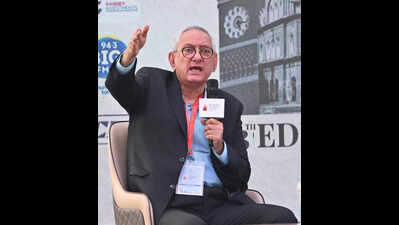

Lucknow: Former Mumbai police commissioner Rakesh Maria on Saturday offered rare insights into the meticulous planning behind contract killings in the city’s underworld, dispelling popular perception that such murders are impulsive, quick acts executed in minutes.“You may have seen on television, a bike comes, shots are fired and the killers vanish. In reality, contract killings are result of extraordinary patience and meticulous planning,” Maria said while speaking at a public interaction during a session at the Metaphor Literary Festival.Explaining the anatomy of organised crime hits, Maria said every such killing is preceded by months of surveillance, profiling, and psychological conditioning. “Every movement of the target is studied — when he is guarded, when he is exposed and when he is vulnerable,” he said, stressing that identifying the precise moment of weakness was central to such operations.Illustrating his point, Maria recalled the killing of underworld figure Abdul Majid of the Pathan gang in 1986. Majid, he said, was heavily guarded whenever he stepped out, making a street attack nearly impossible. His only vulnerability lay inside his home, though even that was protected by a ferocious German Shepherd that allowed no stranger to enter.The contract to kill Majid was allegedly given to Munna Bhanwarlal Gupta, also known as Manoj Bhanwarlal Gupta, a hardened criminal whom Maria later arrested in connection with the 1993 Mumbai blasts. According to Maria, Gupta spent nearly four months executing the plan. He first befriended Majid’s domestic help, who walked the dog daily and slowly gained the animal’s trust by feeding it biscuits every day.On Apr 29, 1986 — coincidentally Dawood Ibrahim’s wedding anniversary — Gupta calmly walked into Majid’s residence. Mistaking his presence as familiar because of the dog’s wagging tail, the household allowed him entry. Gupta first shot the dog and then killed Majid before walking out unchallenged.“For me, this remains one of the most chilling examples of the planning that goes into a contract killing,” Maria said, adding that such crimes are never random.Maria said the subsequent elimination of Abdul Samad Khan and Hamid, both key Pathan gang members, fundamentally altered the balance of power in Mumbai’s underworld. “If Samad Khan and Hamid were alive, Dawood Ibrahim would never have risen the way he did. They terrified him,” Maria said, asserting that their removal paved the way for Dawood’s emergence as the city’s most powerful crime boss.Reflecting on his career, Maria said his exposure to the underworld deepened during the 1993 blasts investigation, when gathering intelligence on organised crime became a core responsibility. He spoke of hours spent studying police records, court documents, and interacting with former gang leaders such as Karim Lala and Haji Mastan, whose accounts offered a rare window into the evolution of Mumbai’s crime syndicates.Maria traced Dawood Ibrahim’s early years, noting that his father, Ibrahim Kaskar, a head constable in Mumbai Police, initially acted as an informal intermediary between the police and local gangs. “Police believed Dawood could be controlled. Instead, he turned into a Frankenstein,” said Maria, adding, “They were rising on one side, and on the other was Dawood Ibrahim. At the time, the thinking was simple — when there are big fish in a pond, you send in a smaller one to gather information and help manage them. Dawood was sent in with that intent. Instead of controlling the pond, he became its most voracious predator. By the time the police realised what happened, it was already too late,” Maria said.Recalling a turning point, Maria said that on Apr 6, 1986, Mumbai Police arrested Charles Sobhraj from Goa. Following this, then commissioner of police D S Soman held a crime meeting and told senior officers that if the police could catch someone like Sobhraj, there was no reason why other major criminals could not be apprehended.“That was the moment the heat intensified,” Maria said. “Soon after, Dawood disappeared from the country — sometime between mid-May and early Jun 1986.”Maria then referred to Dongri, describing a particular rock in the area as almost sacred, symbolising how deeply belief, fear and superstition were intertwined in Mumbai’s underworld during that era.Maria further said Dawood, who is Ibrahim Kaksar’s second son, was believed to be destined for prominence after a seer predicted he would bring great name and influence to the family, a belief that led to his enrolment in an English-medium school.