City residents lose 6.5 yrs of life due to poor air quality: Report | Lucknow News
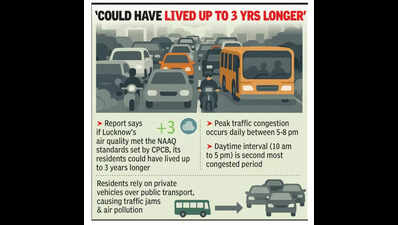

Lucknow: Residents in Lucknow may have lost 6.5 years of their lives compared to those living in a region meeting the WHO stipulated safe guidelines for PM2.5.A report titled ‘From Gridlock to Green Inclusive Mobility – Analysing Traffic Air Quality, and Public Transport Opportunities in Lucknow’ — which was unveiled by The Climate Agenda, a grassroots-driven not-for-profit organisation working to build climate-conscious communities — reflected the severe impact on health caused by air pollution due to emissions from the traffic congestion. Citing The Chicago Energy Policy Institute 2020 report that calculated life expectancy impacts of air pollution based on national standards, it mentions that residents in Lucknow may have lost 6.5 years of their lives compared to those in a region meeting the WHO stipulated safe guidelines for PM2.5. According to the report, if Lucknow’s air quality met the National Ambient Air Quality Standards set by the Central Pollution Control Board (CPCB), its residents could have potentially lived up to 3 years longer.The report also stated that peak traffic congestion in Lucknow occurs daily between 5 pm and 8 pm. Highlighting the current state of public and private transport in Lucknow, the report reveals that residents rely on privately owned vehicles (51% two-wheeler and 29% private car) over public transport, causing long hours of traffic congestion and a significant increase in air pollution at breathing heights.With the highest vehicle population in India and severe air quality challenges across its urban centres, Uttar Pradesh stands at a critical juncture to lead India’s electric vehicle (EV) transition. In this context, The Climate Agenda, unveiled a commissioned report titled ‘From Gridlock to Green Inclusive Mobility – Analysing Traffic Air Quality, and Public Transport Opportunities in Lucknow’ and ‘Assessment of Uttar Pradesh Electric Vehicle Manufacturing and Mobility Policy 2022’.The ground-level evidence, research, and assessment done in collaboration with IIT-BHU and Envirocatalysts aim to anchor clean and inclusive mobility in public consciousness and influence decision-making processes.‘From Gridlock to Green Inclusive Mobility – Analysing Traffic Air Quality, and Public Transport Opportunities in Lucknow’ analysed the socio-economic impact of new vehicle registration, traffic congestion, and air pollution.According to TomTom Traffic Data from Aug 2024, the congestion at various traffic corridors showed that most parts of Lucknow city experienced chronic congestion, revealing a significant variation between weekday and weekend traffic patterns. Analysis shows that the peak congestion occurs daily between 5 pm and 8 pm, when median traffic speeds reach their lowest levels, followed by the daytime interval (10 am to 5 pm), which is the second most congested period.Highlighting the findings of the report, Ekta Shekhar, director of The Climate Agenda, said, “Both studies underline the need for a comprehensive strategy to transform the state into a competitive hub for investment, innovation, and sustainable urban living. Our call-to-action through these findings is to start a discourse at political and policy leadership for making people-centric, inclusive, and climate-resilient urban mobility.“The ‘Assessment of Uttar Pradesh Electric Vehicle Manufacturing and Mobility Policy 2022′ report presents a detailed gap analysis, identifying areas where the policy can be strengthened to match the clarity, inclusivity, and depth of more advanced EV frameworks.The assessment underlines that as EV adoption accelerates nationwide, the time is opportune for Uttar Pradesh to refine its approach by incorporating emerging best practices and learnings from other leading states.Sunil Dahiya, founder and lead analyst, EnviroCatalysts, said, “Lucknow’s challenges like traffic congestion, air pollution, and preference for private transport are interlinked and demand urgent solutions.”Abhisek Mudgal, assistant professor, civil engineering, IIT-BHU, said, “Lucknow, like many other urban areas, is at a crossroads where smart traffic management, stronger bus corridors, and clean mobility can cut vehicular emissions and ease traffic congestion.”The reports are commissioned by The Climate Agenda, with EnviroCatalysts and IIT-BHU leading the empirical research mandate.