Stubborn stains on our civic manners | Lucknow News
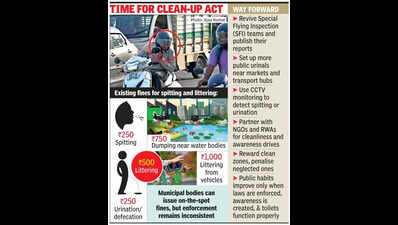

Lucknow: Public spitting and urination continue unchecked across the city due to poor enforcement of existing rules and penalties.Major landmarks, busy markets, and even heritage sites bear stains, foul odours, and overflowing bins—clear signs of the gap between regulations and ground reality. As per the Uttar Pradesh Solid Waste Management and Cleanliness Rules, 2021, the Lucknow Municipal Corporation is empowered to impose on-the-spot fines of Rs 250 for public spitting or urination. However, a TOI reality check revealed that these penalties are seldom implemented. From Bada Imambara and Rumi Darwaza to Charbagh, Alambagh, Hazratganj, and Indiranagar, paan stains, foul corners, and neglected urinals are a common sight. Many public toilets are locked or without water, forcing people to use open areas. Even tourist spots like Bada Imambara have spit marks and litter. Vendors near Rumi Darwaza said municipal teams “rarely visit” now. “Earlier, there was fear of fines, but no one checks anymore,” said a tea-seller. This neglect not only spoils the city’s look but also damages its image as a historic and cultural centre. According to former environment officer Sanjeev Pradhan, each LMC zone has a Special Flying Inspection (SFI) team tasked with penalizing violators. However, the system has nearly collapsed. “In 2024, fewer than 50 people were fined across the city, compared to over 1,200 two years earlier,” a senior officer revealed. An LMC official, seeking anonymity, admitted that enforcement has slowed due to staff shortages and multiple duties. “The pace has dropped, but special cleanliness and fine drives will resume soon. We’re also working with NGOs for awareness campaigns,” the official said. Many residents feel that the lack of fear among violators has rendered the rules ineffective. “There are rules, but no fear,” said Ramesh Gupta, a Charbagh hotel owner. “People know they can get away with it. Until fines are increased and enforced strictly, nothing will change.” Students and youth echo this view. Priya Tiwari, a student from Indiranagar, said, “We learn about cleanliness in school, but outside, the city tells a different story. Awareness is fine, but action is missing.” Environmental activist Mohammad Haider emphasized the need for civic pride and better infrastructure. “Defiling monuments with spit dishonors our heritage. We must install clear signage, deploy custodians, and make people feel responsible for their city,” he said. “Civic sense is not built overnight; it must be nurtured from the classroom to the community, habits like public urination or spitting reflect not just ignorance but the absence of early civic education. With rapid migration from villages to cities, the govt must plan preventive civic awareness and infrastructure in advance rather than react when situations spiral out of control,” said DR Sahu, head of the department of sociology, Lucknow University. From a public health perspective, Dr Manish Kumar Mannar of KGMU warned that public spitting can spread diseases like tuberculosis and Covid-19 while open urination leads to soil and groundwater contamination. “Cleanliness is not only about aesthetics; it’s about preventing infections,” he stressed. Civic activists are demanding that LMC publish quarterly reports on enforcement and penalties. “Swachh Bharat cannot succeed without functioning enforcement teams and regular reports,” said activist Sharad Patel. “We need transparency — people should know how many were fined and how often teams operate.”